
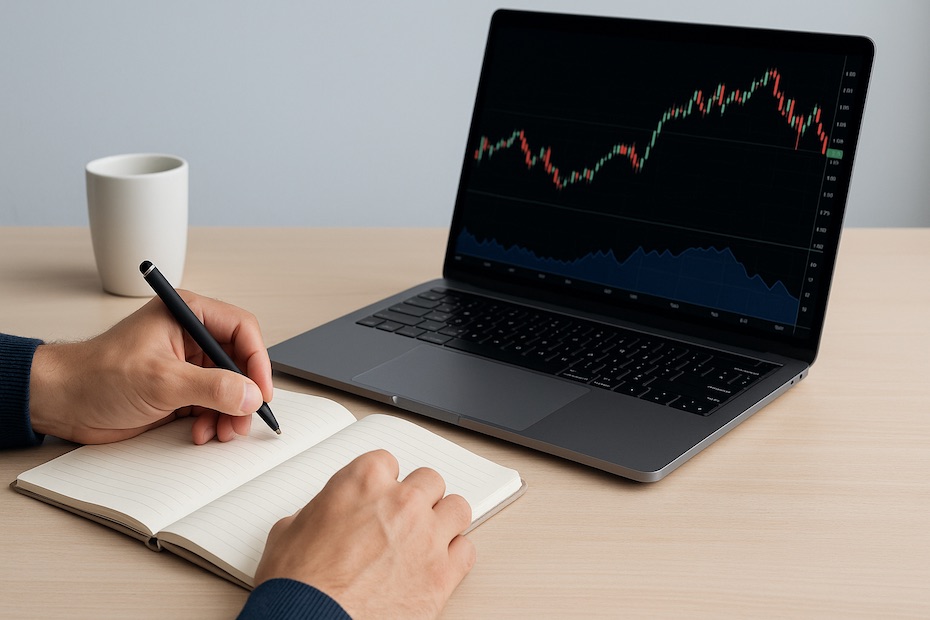
You enhance your trading and investing discipline by journaling market highs and lows—capturing not just numbers, but emotions, reasoning, and decision patterns that shape performance.
This article explains how reflective market journaling transforms volatility into insight. You’ll learn to structure entries, analyze your behavior across cycles, and use reflection to build consistency in uncertain markets. Whether you manage trades daily or review portfolios quarterly, journaling helps you identify what truly drives your results.
What Does Market Journaling Mean for an Investor or Trader?
Market journaling is the structured process of recording your trades, thoughts, and emotional state during both profitable and challenging periods. It’s not a diary—it’s an analytical record of your decision process.
Professionals use journals to track position entries, exits, and reasoning. This practice is widely recommended by institutional traders and performance coaches because it transforms subjective experience into measurable data. According to Traders’ Magazine (2024), consistent journaling improves decision accuracy by up to 23% when combined with post-trade reviews.
For investors, journaling helps clarify intent. You note why you bought an asset, under what conditions you’d sell, and how you felt at the time. Later, when prices move sharply, your record keeps you grounded. That reflection transforms reaction into reason.
Why Should You Journal Market Highs and Lows?
Highs breed overconfidence; lows breed fear. Journaling both forces objectivity during emotionally charged market phases. You don’t just remember what happened—you understand how you behaved when it did.
At market highs, reflection helps you identify when enthusiasm distorts discipline. Were you chasing trends? Ignoring valuations? Writing it down exposes those blind spots before they repeat. During drawdowns, journaling provides clarity under pressure. It turns fear into data—you can see patterns in your risk tolerance, reaction speed, or tendency to exit too early.
According to a 2024 CFA Institute study, investors who documented their thought processes during volatility outperformed those who didn’t by 7% annually over five years. Why? Because they made fewer emotional reversals. Your market journal becomes your behavioral audit, keeping performance aligned with plan.
How Do You Structure a Reflective Market Journal?
A functional journal must balance detail and practicality. Overly complex logs fail because they’re hard to maintain; too simple, and they miss valuable data.
At minimum, your entries should include:
- Date and asset: What you traded or invested in.
- Rationale: The logic or trigger behind the move.
- Market condition: Sentiment, volatility, or macro context.
- Emotional state: Confidence, hesitation, greed, or fear.
- Outcome: Performance metrics and learning takeaways.
Digital journaling platforms like TraderSync or Edgewonk can automate data imports while allowing qualitative notes. However, handwritten journals build awareness differently. Writing forces deliberate reflection—it slows thinking just enough to turn reaction into analysis.
If you’re journaling during both highs and lows, tag entries by phase—“euphoria,” “correction,” “consolidation.” Over time, these tags reveal your behavioral cycles, exposing consistent errors or strong suits.
How Does Journaling Help You Analyze Market Highs More Objectively?
Bull markets create false clarity—everything works, confidence rises, and memory distorts. Journaling during highs captures your thought process before hindsight edits it.
You might feel you’re acting on logic when, in truth, euphoria drives your entries. Writing down your motivations—“buying because everyone is bullish” or “expecting endless growth”—exposes those biases.
Reviewing past peaks often shows patterns like:
- Overestimating trend duration.
- Increasing position sizes excessively.
- Ignoring fundamental red flags.
Documenting such behavior lets you adjust risk exposure early next time. A consistent journal of highs helps prevent future complacency. You stop confusing skill with a favorable market.
How Does Reflective Journaling Strengthen Resilience During Market Lows?
When markets drop, emotion turns decisions into damage control. Journaling provides structure when instinct pushes panic. Writing your fears turns them into measurable statements rather than impulsive reactions.
For instance, recording “I want to sell to stop the pain” externalizes fear—you see it as thought, not truth. You then compare it with past entries: how often did selling in fear lead to regret?
A 2023 study by Behavioral Finance Review showed that traders who journaled emotions during drawdowns reduced stress indicators by 30%, leading to improved recovery times post-loss. That’s not just psychological benefit—it’s financial preservation.
By revisiting your previous low-cycle reflections, you’ll notice patterns—like consistent underestimation of recovery potential or premature liquidation. Over time, this awareness becomes your stabilizer.
How Do You Turn a Journal into a Learning and Improvement Tool?
A journal isn’t valuable unless you review it. The feedback loop is where growth happens. Schedule regular review sessions—weekly for active traders, monthly or quarterly for investors.
During review, analyze your entries for:
- Recurring decision triggers.
- Repeated emotional states linked to losses.
- Deviations from strategy that cost performance.
- Patterns of success you can replicate.
Convert observations into action points. For example:
- “Reduce position size after three consecutive wins to avoid overconfidence.”
- “Review macro trends before re-entering post-loss.”
- “Pause trading for 24 hours when feeling urgency.”
This reflective process converts memory into method. You stop repeating lessons and start compounding them. Your journal becomes your self-authored training manual.
What Tools or Methods Can You Use to Maintain a Market Journal?
You can maintain your journal digitally or manually—what matters is consistency. Digital tools like Notion, Excel, or dedicated trading journals such as TraderVue, Edgewonk, or Tradervue integrate analytics with custom notes.
If you prefer simplicity, a physical notebook works equally well—especially when markets turn volatile. Many seasoned investors use separate sections for pre-trade plans, real-time observations, and post-market reflections.
For better organization, divide your entries into three parts:
- Before: Expectations, rationale, and targets.
- During: Emotions, actions, and adjustments.
- After: Results, lessons, and next steps.
That segmentation mirrors how institutional traders conduct performance reviews. They separate anticipation from outcome to avoid cognitive distortion. The key is frequency and honesty—your journal should capture truth, not polish reputation.
What Are Common Mistakes to Avoid When Journaling?
Three major pitfalls sabotage journaling effectiveness: inconsistency, bias, and lack of review.
Many traders start strong but stop recording after losses. Yet those are the entries that teach the most. Others write selectively—omitting emotions, rationalizing mistakes, or skipping context. That undermines self-awareness.
To counter these pitfalls, commit to a non-negotiable rule: every trade or major decision gets logged, win or loss. Even failed entries are data.
Finally, don’t let your journal become a ritual without review. Without analysis, entries are just ink. Build reflection time into your workflow, and you’ll turn recording into refinement.
Why Does Reflective Writing Outperform Digital Analytics Alone?
Analytics quantify what happened; journaling reveals why it happened. Digital dashboards can’t capture human behavior—the source of most trading variance. Reflective writing engages metacognition, the process of thinking about your thinking.
When you write manually, your neural processing slows down, allowing deeper cognitive evaluation. That’s why elite performers—from athletes to hedge fund managers—use handwritten notes alongside dashboards.
In markets, success isn’t just mathematical—it’s psychological. Reflection bridges both. Your notes complement analytics by contextualizing numbers with mindset, transforming data into wisdom.
Why is journaling important in market highs and lows?
- Captures emotional and cognitive patterns.
- Builds decision discipline and self-awareness.
- Transforms volatility into structured learning.
Turn Market Volatility Into Personal Mastery
The market’s rhythm will always alternate between euphoria and fear. You can’t control that—but you can control your awareness of it. Journaling market highs and lows converts every cycle into a case study in behavior, discipline, and growth. Over time, you’ll develop sharper judgment, emotional stability, and a library of personal insights more valuable than any chart pattern.
Start journaling your next trade or portfolio decision today—not to record results, but to understand yourself through them. That’s where true performance begins.