
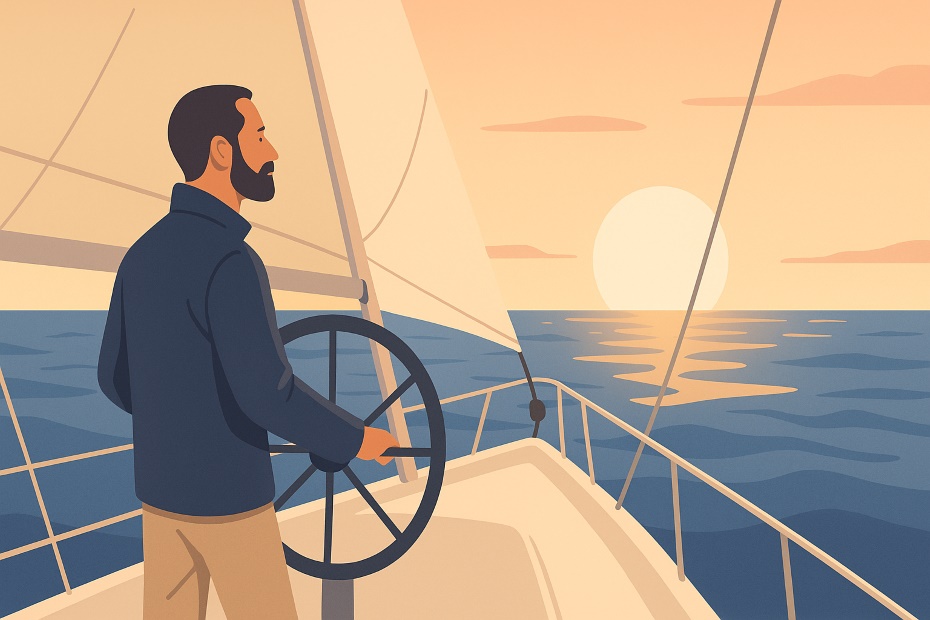
Sailing across the Pacific refines your leadership in ways few boardrooms can. It strips you down to precision, composure, and humility—demanding command without ego and decision without noise.
In this article, you’ll explore how long-distance sailing becomes a form of executive meditation. You’ll see how the solitude, uncertainty, and scale of the ocean force you to develop clarity, teamwork, and resilience—the same traits that separate average leaders from extraordinary ones.
What Leadership Lessons Does Sailing Teach That Boardrooms Can’t?
When you take command of a vessel in open waters, you assume full accountability—there’s no “passing the decision.” Leadership becomes literal: lives depend on your clarity. The Pacific doesn’t accept excuses or ambiguity.
Unlike in boardrooms, where authority comes with title or seniority, leadership at sea must be earned. Your crew follows because they trust your skill, not your status. Every decision—trim, tack, or turn—must be explained and timed with precision. There’s no hiding behind jargon or committees.
This parallels executive leadership in volatile markets. The best leaders don’t delegate away uncertainty—they navigate through it. They communicate intent clearly, allocate roles efficiently, and act decisively when conditions shift. Just like on a sailboat, competence commands respect; talk without execution capsizes teams.
Real-world sailors like Elise Sivilay, who led a racing crew, observed that leadership on water requires balance: “It’s not a democracy—but it’s not a dictatorship either. You must decide quickly and still make people feel valued.” That’s the leadership rhythm every executive should master.
How Does Silence and Solitude Refine Leadership Presence?
Open-water sailing isolates you from the world’s noise. Days pass without signal, without distraction, without validation. What remains is you—your thoughts, instincts, and endurance.
That isolation transforms into leadership meditation. When you sit in silence with nothing but ocean and sky, you begin to notice how scattered your mind normally is. You see how impatience, worry, and constant motion dull judgment. In stillness, presence sharpens.
Research has shown that solitude improves focus and emotional regulation. Sailors often report that long crossings train them to pause before reacting—an ability every leader needs in high-pressure decision cycles.
Leadership presence isn’t charisma—it’s clarity. When you’re grounded in your internal rhythm, you speak slower, decide cleaner, and inspire steadier confidence. The ocean teaches this naturally: there’s no shortcut to calm, only practice.
When you return to your organization after such reflection, you carry that mental silence with you. Meetings feel slower, conflicts feel smaller, and urgency feels manageable. Silence becomes your strategic advantage.
How Do You Manage Drift—Both at Sea and in Strategy?
Every sailor knows drift is inevitable. The wind shifts, currents pull, and even small deviations compound over time. Ignore it long enough, and you’ll miss your destination entirely.
Leadership drift happens the same way. You start with a mission, but small compromises—on quality, communication, or culture—shift your course gradually. Without correction, you wake up one quarter later miles off target.
At sea, you learn to recalibrate constantly. You monitor your heading, check coordinates, and make micro-adjustments every hour. Great leaders do the same with metrics and people—they track leading indicators and correct before problems harden.
This mindset creates operational agility. You learn to measure not just outcomes but trajectory. You don’t wait for failure to act—you course-correct early.
If you want your leadership to stay true under pressure, you must behave like a navigator, not a passenger. Real alignment is never set-and-forget—it’s measured, recalibrated, and maintained through attention.
This discipline turns drift from danger into insight. It transforms leadership from reactive management into deliberate navigation.
How Does Crew Management Reflect High-Performance Team Leadership?
On the open sea, crew dynamics reveal themselves instantly. When fatigue, weather, and risk combine, weak communication collapses systems.
A captain must set tone and rhythm. You delegate based on skill, clarify intent before execution, and ensure every person understands not just what to do—but why it matters. That shared understanding keeps teams cohesive under stress.
When a gust hits or a sail tears mid-storm, the best captains don’t yell—they recalibrate and redistribute. The same holds true in business. You can’t prevent turbulence, but you can decide whether your team fractures or functions through it.
Every sailor’s role is interdependent. The person on the winch relies on the lookout. The lookout trusts the helmsman. The helmsman trusts the navigator. That chain of trust mirrors cross-functional leadership in complex organizations.
Executives who lead like captains build trust through competence and communication—not through hierarchy. You teach your crew to anticipate rather than await orders. You reward initiative and prepare redundancy. Leadership at its highest form becomes shared stability, not isolated authority.
What Does the Ocean Teach About Resilience and Endurance?
Crossing the Pacific is less about heroics and more about rhythm. You manage fatigue, nutrition, maintenance, and mood over weeks. It’s not adrenaline that gets you across—it’s pacing.
The same applies to executive leadership. Burning out your team or yourself may deliver short-term wins, but it undermines the long game. Sustainable performance comes from controlled energy output, realistic expectations, and measured recovery.
At sea, you learn to respect constraints: fuel, food, rest, and daylight. You learn that even small overexertions have delayed costs. The ocean punishes excess.
This recalibrates your leadership ego. You stop glorifying exhaustion and start valuing balance. The most resilient leaders act less like sprinters and more like navigators—adjusting sails, not forcing motion.
Resilience becomes not just the ability to push through, but the wisdom to sustain. You understand that consistent navigation wins the voyage, not sporadic speed.
How Does Pattern Recognition Strengthen Strategic Awareness?
A skilled sailor reads patterns—wind direction, swell formation, sky changes. Small details hint at future shifts. Those who miss signals react late; those who see early adjust effortlessly.
This heightened awareness mirrors strategic foresight in leadership. You start noticing subtle trends—team fatigue before burnout, customer dissatisfaction before churn, competitor movement before disruption.
Pattern recognition is an acquired skill, not an inherited one. It comes from attentiveness and experience. You must practice seeing links between seemingly unrelated variables—the same way a sailor senses wind direction from cloud shadows.
Executives who cultivate pattern literacy act faster and with less noise. They don’t need more data—they need more observation. The difference between reaction and readiness lies in seeing patterns others ignore.
In business, as in sailing, this sensitivity to change defines longevity. It’s not the strongest or fastest companies that endure—it’s the most aware.
How Does Sailing Cultivate Mindfulness in Action?
Meditation at sea doesn’t mean stillness—it means immersion. You become so attuned to your environment that you respond instinctively yet calmly.
Mindfulness in leadership isn’t detachment—it’s deliberate awareness amid motion. It’s being fully present during a board meeting, negotiation, or crisis. You’re not waiting to speak; you’re listening deeply and acting with precision.
Open-water sailors describe this as “the quiet between the gusts”—a heightened alertness that’s calm, not tense. That’s the same presence elite leaders exude under pressure. They stay grounded, observe completely, and move decisively.
If you bring that sailor’s stillness into leadership, you stop reacting to surface noise and start navigating beneath it. You begin leading from clarity, not compulsion.
How Do You Anchor Lessons From Sea to Shore?
The hardest part of a voyage isn’t the crossing—it’s retaining what it taught you once you’re back on land. The world’s speed threatens to erode your sea-earned stillness.
To integrate these meditative lessons, you must ritualize reflection. Keep a leadership log. Write post-meeting notes on energy, clarity, and course drift. Block short silent intervals daily—your “mental horizon checks.”
Bring nautical discipline into your routines: check systems, forecast shifts, and recalibrate course weekly. Embed those principles into team culture—short syncs, honest weather reports, and open communication.
By treating your organization like a vessel in constant motion, you transform your sea experience into sustainable leadership practice.
Core Leadership Lessons From Sailing
- Leadership must be earned through competence and calm.
- Silence enhances presence and decision clarity.
- Drift correction defines strategic alignment.
- Teams thrive under clear roles and trust.
- Resilience means pacing, not pushing.
- Awareness grows from attention, not analytics.
Lead With the Depth of the Ocean
Sailing the Pacific changes how you lead—it strips away pretense and exposes the essence of discipline, composure, and awareness. The ocean teaches you to command without ego, adapt without panic, and navigate without noise. When you bring that meditative discipline ashore, your leadership stops reacting—it starts guiding.
If you’d like to explore more leadership practices inspired by endurance, awareness, and real-world strategy, connect with me on my Medium profile. You’ll find essays, routines, and frameworks designed to help leaders build clarity as steady as the sea.