
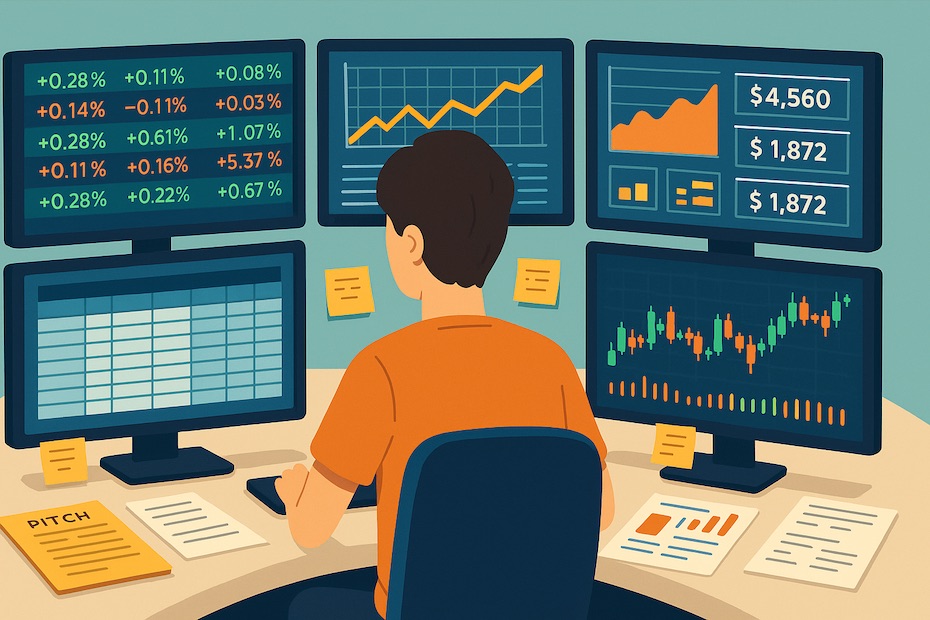
A teenager on the trading floor is forced to learn speed, structure, and precision—fast.
This article offers a real-world breakdown of what it’s like to work on a trading floor at 17. You’ll walk through mental shifts, market decision-making, and how this early exposure to high-stakes environments shapes the foundation for long-term performance in finance and entrepreneurship.
What’s it like working on a trading floor as a teenager?
You step into a pressure cooker where every second counts, and no one waits for you to catch up.
At 17, you’re not observing—you’re executing. Whether you’re tracking real-time equity pricing or interpreting shifts in bond spreads, the margin for error disappears. The noise, the movement, and the flow of orders create an environment where decision-making speed becomes your primary asset. You don’t spend your day learning; you spend it reacting, measuring, and recalibrating.
In that first month, what shocks you is how quickly intuition starts to develop. You begin to sense where liquidity is drying up, or when a trade isn’t about fundamentals but sentiment. Those signals aren’t in textbooks—they’re in the rhythm of execution and human behavior under market stress.
How do you build credibility in a room full of professionals?
You do it through consistency, not cleverness.
On a floor where veterans have decades of trade history, your role isn’t to “show brilliance.” It’s to be exact, timely, and useful. At 17, that means handling order sheets accurately, logging transactions flawlessly, and anticipating what your senior wants before he says it. Your value comes from reliability.
You might not manage a book, but if you can manage expectations, your presence earns respect. Analysts and junior traders who rise fastest are the ones who focus on being indispensable—not interesting.
What lessons does real-time trading teach that simulations can’t?
Simulations let you reset. Real money doesn’t.
The difference between simulation and live trading is emotional consequence. You learn what it feels like to watch a winning position unravel because of hesitation, or to misquote a bid and cost a desk thousands. In that moment, performance is tied to control—not clever forecasting.
You also realize quickly that market intelligence isn’t just about models. It’s about market psychology—how traders front-run news cycles, manage positioning into CPI prints, or time liquidity during options expiration. That’s data you gather by exposure, not education.
What habits separate successful junior traders from the rest?
You must develop discipline around feedback and execution.
Top performers at 17 build structure into their workday: morning prep, execution logs, afternoon reviews, and end-of-day recaps. They treat each task—no matter how small—with operational sharpness. That habit converts to speed, and speed matters when you’re tracking a dozen equity baskets moving against headline risk.
Around 500–600 words into that job, if you’ve built that habit system, you’ll find your edge. Key daily habits that matter:
- Review open and closed trades nightly
- Annotate entry/exit reasons for each transaction
- Track emotional triggers and decision fatigue
- Adjust playbooks weekly based on macro news flow
- Defer to execution logic over instinct under stress
This process converts you from reactive to proactive—even under volatility.
How do you learn to manage pressure when your age is your biggest liability?
You shut up and listen. Then you deliver.
When you’re 17 in that room, people expect you to make mistakes. The only way to rewrite that assumption is by showing you don’t panic. You deliver calmly during earnings season. You recover after a failed hedge. You execute block trades without flinching.
Pressure isn’t something you overcome by avoiding it—it’s something you normalize through exposure. The floor doesn’t reward panic recovery; it rewards seamless execution. Your reputation builds on how you respond when trades go wrong.
What mindset shifts occur after working on a trading floor early?
You stop focusing on being right—and start focusing on execution quality.
At that stage, your instinct will be to focus on signal prediction. But real trading teaches you that entries don’t matter as much as exits. That models fail. That news breaks your setup. So your focus turns inward: Did you follow risk? Did you execute clean? Did you cut fast enough?
Those are professional questions. You realize early success isn’t defined by how many trades you win. It’s about how little you lose when wrong—and how fast you course-correct.
How does this experience change your career trajectory?
You enter the workforce with a strategic edge most don’t gain until their 30s.
The ability to think under pressure, anticipate flow, and manage downside makes you valuable across finance, operations, or entrepreneurship. You’re fluent in execution, aware of the role of narrative in markets, and fluent in systems thinking.
By the time others are learning trade execution in training programs, you’re optimizing it. Your instincts are sharper, your exposure wider, and your feedback loop tighter—all because you started at 17 when stakes were high, and expectations were higher.
What does a teenager gain from working on a trading floor?
- Risk tolerance under stress
- Real-time execution habits
- Precision in market decision-making
- Discipline built from accountability
- Career advantage in finance and leadership
In Conclusion
Working on a trading floor at 17 transforms how you think, react, and build habits under stress. You don’t leave with just knowledge—you leave with systemized discipline, market-tested reflexes, and an edge that compounds across every future venture. Start early, build structure, and operate with precision.
To explore more about early-stage market training, execution discipline, and entrepreneurial finance, visit Clifford Boro’s Crunchbase profile. Clifford’s work at the intersection of trading, tech, and education reflects the power of building skill under pressure—starting young and scaling fast.